Support

Comprehensive Guide to KLOW Peptide Blend: Dosage, Advantages, and Potential Side Effects
Add 2 mL of bacteriostatic water and every 10 units on a U-100 insulin syringe (0.1 mL) delivers one twentieth of the vial. Most people use vial form for systemic effects. KLOW can be delivered through vial-based administration (subcutaneous or intramuscular), topical preparations, or in some cases orally. The target is the structural integrity of the gut wall itself. Together, they address “leaky gut” by reducing inflammation and repairing damaged intestinal lining at the same time.
It promotes cell migration and angiogenesis, both of which tissue repair depends on. It’s particularly interesting because it reinforces barrier integrity, whether that’s your gut lining or your skin. KPV has been studied for gut inflammation (colitis) and skin conditions (dermatitis) because it reduces cytokine-driven damage while maintaining normal immune function. At 50mg it’s also the bulk of the vial by weight, which matters for the reconstitution math later. Having it systemically in KLOW means it’s working on connective tissue throughout the body instead of one patch of skin.
So klow is essentially “glow plus KPV” with a higher concentration, chosen when inflammation or gut support is also part of the goal. Together they are used for skin quality, recovery, and inflammatory or gut-related research. The KPV addition is why people choose klow over glow. None have been formally measured in a controlled study of the blend.
Steps to Confirm the Authenticity of a COA
The visual takeaway is that KLOW’s protocol is a fading frequency pattern laid over a flat dose line. In weeks 1–4 every cell is filled (seven 10-unit doses). Consistency of timing matters more than the exact hour — pick a slot and keep it. Every dose is the same 0.10 mL / 10 units; only the frequency changes across phases.
Royal Peptides supplies compounds intended for controlled laboratory research and analytical applications. Not for human or animal use, consumption or self-administration. Royal Peptides supplies research compounds to qualified adults for in-vitro laboratory use.
This reference is ghk-cu.com published for laboratory research documentation. Peptides referenced are not approved for human therapeutic use in most jurisdictions; always consult a qualified clinician. In the documented protocol a consistent daily slot is chosen, sites are rotated, and the schedule is kept — consistency is the goal. The documented cycle is 8–12 weeks on, then 4–8 weeks off.
This guide answers those questions using primary preclinical literature rather than marketing claims. See what is inside, why it is blue, KLOW vs GLOW, and a dosage reference chart. Community-reported protocol Vials per Cycle (12wk) Loading only (4 wks @ 5x/wk) 1 Standard cycle (12 wks) 2-3 High-frequency protocol (daily, 10 wks) 3-4 This article reports what has been documented, not what should be done.
Recording the applicable lot reference helps maintain traceability between the research material, supporting documentation, and laboratory records. Royal Peptides does not provide dosing, administration, injection, prescribing, treatment, or personal-use instructions for KLOW™ or its individual research components. Record the KLOW™ product identifier, stated composition, applicable batch or lot reference, date received, and laboratory reference information.
This stack leverages multiple pathways to create a powerful anabolic and recovery environment. KLOW is incredibly versatile and can be used as a standalone recovery protocol or stacked with other compounds to enhance overall performance and results. Together, these peptides create a powerful synergy, addressing recovery from multiple angles.
For anyone dealing with inflammatory conditions, this mechanism matters. A pilot study in women with interstitial cystitis found 10 of 12 patients achieved complete symptom resolution. Toxic effects only occur at doses around 22,500mg—literally thousands of times higher than therapeutic doses. Four decades of research have documented remarkable effects. It’s systematic biological optimization, targeting multiple repair pathways simultaneously. Related compounds and blends are comparisons only, not interchangeable.
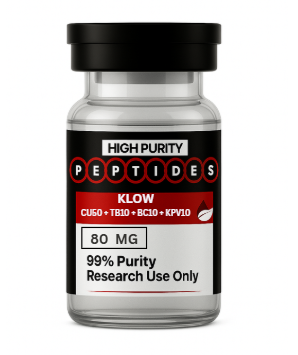
Collagen and elastin synthesis, endothelial activity and fibroblast migration have been measured in cell culture following exposure, which is why it is a common reference compound in extracellular-matrix research. TB-500 (a thymosin β-4 fragment) is studied for cell migration and fibrotic endpoints across several animal models. Blends are supplied for researchers who want to test several pathways at once and compare the result against single compounds. Several peptides are combined and freeze-dried into a single 80 mg vial.

Material may be incorporated into suitably designed experimental workflows based on comparisons or references by qualified laboratories. Researchers can access multiple identified peptide components within a single research sample due to the specified formulation. The individual components or the scientific literature are referenced only to aid in compound identification, provide analytical context, and support research documentation. This is not designed for consumption by humans, nor for diagnostic or therapeutic purposes, or for administration to either humans or animals.
There are no existing published data regarding the combination of KLOW with other compounds. The relevance of TB-500→ systemic cell migration, actin regulation, and connective tissue remodeling is enhanced when the focus is on studying recovery through multiple pathways, as the fixed ratio maintains constancy among the four variables. A study on the Achilles tendon of rats indicated improved healing measures, yet it did not determine recovery outcomes in humans nor evaluate KLOW.